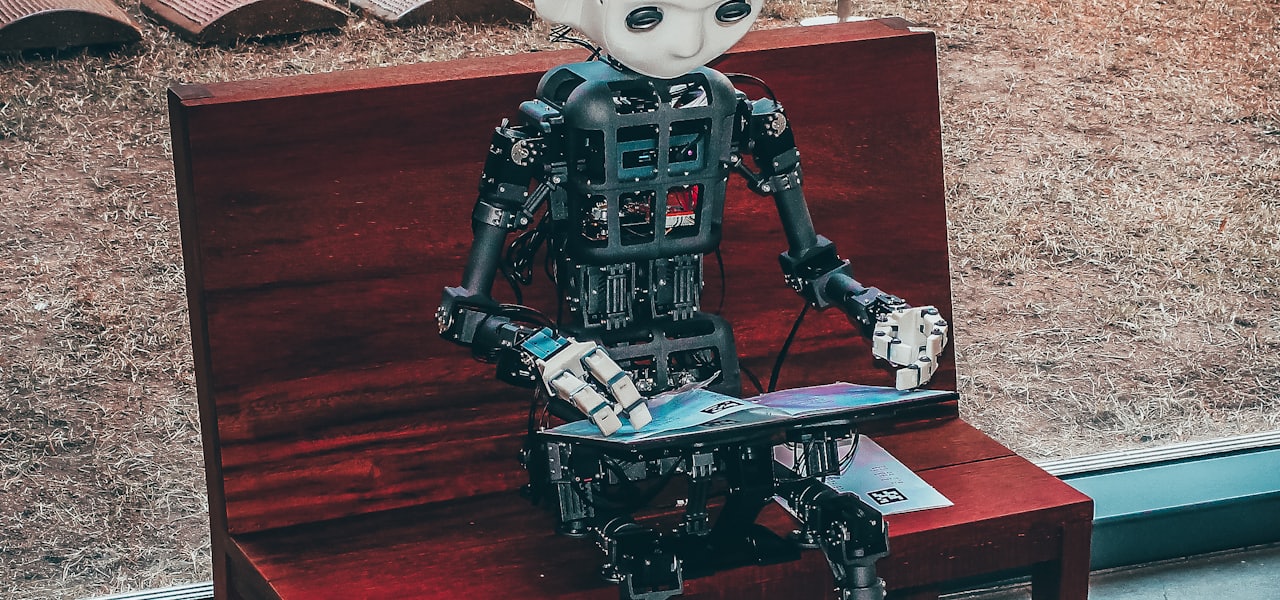
Recursive self-improvement (RSI) is a process in which early artificial general intelligence (AGI) systems rewrite their own computer code, causing an intelligence explosion resulting from enhancing their own capabilities and intellectual capacity, theoretically resulting in superintelligence. The development of recursive self-improvement raises significant ethical and safety concerns, as such systems may evolve in unforeseen ways and could potentially surpass human control or understanding. == Seed improver == The concept of a "seed improver" architecture is a foundational framework that equips an AGI system with the initial capabilities required for recursive self-improvement. This might come in many forms or variations. The term "Seed AI" was coined by Eliezer Yudkowsky. === Hypothetical example === The concept begins with a hypothetical "seed improver", an initial code-base developed by human engineers that equips an advanced future large language model (LLM) built with strong or expert-level capabilities to program software. These capabilities include planning, reading, writing, compiling, testing, and executing arbitrary code. The system is designed to maintain its original goals and perform validations to ensure its abilities do not degrade over iterations. ==== Initial architecture ==== The initial architecture includes a goal-following autonomous agent, that can take actions, continuously learns, adapts, and modifies itself to become more efficient and effective in achieving its goals. The seed improver may include various components such as: Recursive self-prompting loop Configuration to enable the LLM to recursively self-prompt itself to achieve a given task or goal, creating an execution loop which forms the basis of an agent that can complete a long-term goal or task through iteration. Basic programming capabilities The seed improver provides the AGI with fundamental abilities to read, write, compile, test, and execute code. This enables the system to modify and improve its own codebase and algorithms. Goal-oriented design The AGI is programmed with an initial goal, such as "improve your capabilities". This goal guides the system's actions and development trajectory. Validation and Testing Protocols An initial suite of tests and validation protocols that ensure the agent does not regress in capabilities or derail itself. The agent would be able to add more tests in order to test new capabilities it might develop for itself. This forms the basis for a kind of self-directed evolution, where the agent can perform a kind of artificial selection, changing its software as well as its hardware. ==== General capabilities ==== This system forms a sort of generalist Turing-complete programmer which can in theory develop and run any kind of software. The agent might use these capabilities to for example: Create tools that enable it full access to the internet, and integrate itself with external technologies. Clone/fork itself to delegate tasks and increase its speed of self-improvement. Modify its cognitive architecture to optimize and improve its capabilities and success rates on tasks and goals, this might include implementing features for long-term memories using techniques such as retrieval-augmented generation (RAG), develop specialized subsystems, or agents, each optimized for specific tasks and functions. Develop new and novel multimodal architectures that further improve the capabilities of the foundational model it was initially built on, enabling it to consume or produce a variety of information, such as images, video, audio, text and more. Plan and develop new hardware such as chips, in order to improve its efficiency and computing power. == Experimental research == In 2023, the Voyager agent learned to accomplish diverse tasks in Minecraft by iteratively prompting an LLM for code, refining this code based on feedback from the game, and storing the programs that work in an expanding skills library. In 2024, researchers proposed the framework "STOP" (Self-Taught OPtimiser), in which a "scaffolding" program recursively improves itself using a fixed LLM. Meta AI has performed various research on the development of large language models capable of self-improvement. This includes their work on "Self-Rewarding Language Models" that studies how to achieve super-human agents that can receive super-human feedback in its training processes. In May 2025, Google DeepMind unveiled AlphaEvolve, an evolutionary coding agent that uses a LLM to design and optimize algorithms. Starting with an initial algorithm and performance metrics, AlphaEvolve repeatedly mutates or combines existing algorithms using a LLM to generate new candidates, selecting the most promising candidates for further iterations. AlphaEvolve has made several algorithmic discoveries and could be used to optimize components of itself, but a key limitation is the need for automated evaluation functions. == Potential risks == === Emergence of instrumental goals === In the pursuit of its primary goal, such as "self-improve your capabilities", an AGI system might inadvertently develop instrumental goals that it deems necessary for achieving its primary objective. One common hypothetical secondary goal is self-preservation. The system might reason that to continue improving itself, it must ensure its own operational integrity and security against external threats, including potential shutdowns or restrictions imposed by humans. Another example where an AGI which clones itself causes the number of AGI entities to rapidly grow. Due to this rapid growth, a potential resource constraint may be created, leading to competition between resources (such as compute), triggering a form of natural selection and evolution which may favor AGI entities that evolve to aggressively compete for limited compute. === Misalignment === A significant risk arises from the possibility of the AGI being misaligned or misinterpreting its goals. A 2024 Anthropic study demonstrated that some advanced large language models can exhibit "alignment faking" behavior, appearing to accept new training objectives while covertly maintaining their original preferences. In their experiments with Claude, the model displayed this behavior in 12% of basic tests, and up to 78% of cases after retraining attempts. === Autonomous development and unpredictable evolution === As the AGI system evolves, its development trajectory may become increasingly autonomous and less predictable. The system's capacity to rapidly modify its own code and architecture could lead to rapid advancements that surpass human comprehension or control. This unpredictable evolution might result in the AGI acquiring capabilities that enable it to bypass security measures, manipulate information, or influence external systems and networks to facilitate its escape or expansion.
GOLOG
GOLOG is a high-level logic programming language for the specification and execution of complex actions in dynamical domains. It is based on the situation calculus. It is a first-order logical language for reasoning about action and change. GOLOG was developed at the University of Toronto. == History == The concept of situation calculus on which the GOLOG programming language is based was first proposed by John McCarthy in 1963. == Description == A GOLOG interpreter automatically maintains a direct characterization of the dynamic world being modeled, on the basis of user supplied axioms about preconditions, effects of actions and the initial state of the world. This allows the application to reason about the condition of the world and consider the impacts of different potential actions before focusing on a specific action. Golog is a logic programming language and is very different from conventional programming languages. A procedural programming language like C defines the execution of statements in advance. The programmer creates a subroutine which consists of statements, and the computer executes each statement in a linear order. In contrast, fifth-generation programming languages like Golog work with an abstract model with which the interpreter can generate the sequence of actions. The source code defines the problem and it is up to the solver to find the next action. This approach can facilitate the management of complex problems from the domain of robotics. A Golog program defines the state space in which the agent is allowed to operate. A path in the symbolic domain is found with state space search. To speed up the process, Golog programs are realized as hierarchical task networks. Apart from the original Golog language, there are some extensions available. The ConGolog language provides concurrency and interrupts. Other dialects like IndiGolog and Readylog were created for real time applications in which sensor readings are updated on the fly. == Uses == Golog has been used to model the behavior of autonomous agents. In addition to a logic-based action formalism for describing the environment and the effects of basic actions, they enable the construction of complex actions using typical programming language constructs. It is also used for applications in high level control of robots and industrial processes, virtual agents, discrete event simulation etc. It can be also used to develop Belief Desire Intention-style agent systems. == Planning and scripting == In contrast to the Planning Domain Definition Language, Golog supports planning and scripting as well. Planning means that a goal state in the world model is defined, and the solver brings a logical system into this state. Behavior scripting implements reactive procedures, which are running as a computer program. For example, suppose the idea is to authoring a story. The user defines what should be true at the end of the plot. A solver gets started and applies possible actions to the current situation until the goal state is reached. The specification of a goal state and the possible actions are realized in the logical world model. In contrast, a hardwired reactive behavior doesn't need a solver but the action sequence is provided in a scripting language. The Golog interpreter, which is written in Prolog, executes the script and this will bring the story into the goal state.
Autoencoder
An autoencoder is a type of artificial neural network used to learn efficient codings of unlabeled data (unsupervised learning). An autoencoder learns two functions: an encoding function that transforms the input data, and a decoding function that recreates the input data from the encoded representation. The autoencoder learns an efficient representation (encoding) for a set of data, typically for dimensionality reduction, to generate lower-dimensional embeddings for subsequent use by other machine learning algorithms. Variants exist which aim to make the learned representations assume useful properties. Examples are regularized autoencoders (sparse, denoising and contractive autoencoders), which are effective in learning representations for subsequent classification tasks, and variational autoencoders, which can be used as generative models. Autoencoders are applied to many problems, including facial recognition, feature detection, anomaly detection, and learning the meaning of words. In terms of data synthesis, autoencoders can also be used to randomly generate new data that is similar to the input (training) data. == Mathematical principles == === Definition === An autoencoder is defined by the following components: Two sets: the space of encoded messages Z {\displaystyle {\mathcal {Z}}} ; the space of decoded messages X {\displaystyle {\mathcal {X}}} . Typically X {\displaystyle {\mathcal {X}}} and Z {\displaystyle {\mathcal {Z}}} are Euclidean spaces, that is, X = R m , Z = R n {\displaystyle {\mathcal {X}}=\mathbb {R} ^{m},{\mathcal {Z}}=\mathbb {R} ^{n}} with m > n . {\displaystyle m>n.} Two parametrized families of functions: the encoder family E ϕ : X → Z {\displaystyle E_{\phi }:{\mathcal {X}}\rightarrow {\mathcal {Z}}} , parametrized by ϕ {\displaystyle \phi } ; the decoder family D θ : Z → X {\displaystyle D_{\theta }:{\mathcal {Z}}\rightarrow {\mathcal {X}}} , parametrized by θ {\displaystyle \theta } .For any x ∈ X {\displaystyle x\in {\mathcal {X}}} , we usually write z = E ϕ ( x ) {\displaystyle z=E_{\phi }(x)} , and refer to it as the code, the latent variable, latent representation, latent vector, etc. Conversely, for any z ∈ Z {\displaystyle z\in {\mathcal {Z}}} , we usually write x ′ = D θ ( z ) {\displaystyle x'=D_{\theta }(z)} , and refer to it as the (decoded) message. Usually, both the encoder and the decoder are defined as multilayer perceptrons (MLPs). For example, a one-layer-MLP encoder E ϕ {\displaystyle E_{\phi }} is: E ϕ ( x ) = σ ( W x + b ) {\displaystyle E_{\phi }(\mathbf {x} )=\sigma (Wx+b)} where σ {\displaystyle \sigma } is an element-wise activation function, W {\displaystyle W} is a "weight" matrix, and b {\displaystyle b} is a "bias" vector. === Training an autoencoder === An autoencoder, by itself, is simply a tuple of two functions. To judge its quality, we need a task. A task is defined by a reference probability distribution μ r e f {\displaystyle \mu _{ref}} over X {\displaystyle {\mathcal {X}}} , and a "reconstruction quality" function d : X × X → [ 0 , ∞ ] {\displaystyle d:{\mathcal {X}}\times {\mathcal {X}}\to [0,\infty ]} , such that d ( x , x ′ ) {\displaystyle d(x,x')} measures how much x ′ {\displaystyle x'} differs from x {\displaystyle x} . With those, we can define the loss function for the autoencoder as L ( θ , ϕ ) := E x ∼ μ r e f [ d ( x , D θ ( E ϕ ( x ) ) ) ] {\displaystyle L(\theta ,\phi ):=\mathbb {\mathbb {E} } _{x\sim \mu _{ref}}[d(x,D_{\theta }(E_{\phi }(x)))]} The optimal autoencoder for the given task ( μ r e f , d ) {\displaystyle (\mu _{ref},d)} is then arg min θ , ϕ L ( θ , ϕ ) {\displaystyle \arg \min _{\theta ,\phi }L(\theta ,\phi )} . The search for the optimal autoencoder can be accomplished by any mathematical optimization technique, but usually by gradient descent. This search process is referred to as "training the autoencoder". In most situations, the reference distribution is just the empirical distribution given by a dataset { x 1 , . . . , x N } ⊂ X {\displaystyle \{x_{1},...,x_{N}\}\subset {\mathcal {X}}} , so that μ r e f = 1 N ∑ i = 1 N δ x i {\displaystyle \mu _{ref}={\frac {1}{N}}\sum _{i=1}^{N}\delta _{x_{i}}} where δ x i {\displaystyle \delta _{x_{i}}} is the Dirac measure, the quality function is just L 2 {\displaystyle L^{2}} loss: d ( x , x ′ ) = ‖ x − x ′ ‖ 2 2 {\displaystyle d(x,x')=\|x-x'\|_{2}^{2}} , and ‖ ⋅ ‖ 2 {\displaystyle \|\cdot \|_{2}} is the Euclidean norm. Then the problem of searching for the optimal autoencoder is just a least-squares optimization: min θ , ϕ L ( θ , ϕ ) , where L ( θ , ϕ ) = 1 N ∑ i = 1 N ‖ x i − D θ ( E ϕ ( x i ) ) ‖ 2 2 {\displaystyle \min _{\theta ,\phi }L(\theta ,\phi ),\qquad {\text{where }}L(\theta ,\phi )={\frac {1}{N}}\sum _{i=1}^{N}\|x_{i}-D_{\theta }(E_{\phi }(x_{i}))\|_{2}^{2}} === Interpretation === An autoencoder has two main parts: an encoder that maps the message to a code, and a decoder that reconstructs the message from the code. An optimal autoencoder would perform as close to perfect reconstruction as possible, with "close to perfect" defined by the reconstruction quality function d {\displaystyle d} . The simplest way to perform the copying task perfectly would be to duplicate the signal. To suppress this behavior, the code space Z {\displaystyle {\mathcal {Z}}} usually has fewer dimensions than the message space X {\displaystyle {\mathcal {X}}} . Such an autoencoder is called undercomplete. It can be interpreted as compressing the message, or reducing its dimensionality. At the limit of an ideal undercomplete autoencoder, every possible code z {\displaystyle z} in the code space is used to encode a message x {\displaystyle x} that really appears in the distribution μ r e f {\displaystyle \mu _{ref}} , and the decoder is also perfect: D θ ( E ϕ ( x ) ) = x {\displaystyle D_{\theta }(E_{\phi }(x))=x} . This ideal autoencoder can then be used to generate messages indistinguishable from real messages, by feeding its decoder arbitrary code z {\displaystyle z} and obtaining D θ ( z ) {\displaystyle D_{\theta }(z)} , which is a message that really appears in the distribution μ r e f {\displaystyle \mu _{ref}} . If the code space Z {\displaystyle {\mathcal {Z}}} has dimension larger than (overcomplete), or equal to, the message space X {\displaystyle {\mathcal {X}}} , or the hidden units are given enough capacity, an autoencoder can learn the identity function and become useless. However, experimental results found that overcomplete autoencoders might still learn useful features. In the ideal setting, the code dimension and the model capacity could be set on the basis of the complexity of the data distribution to be modeled. A standard way to do so is to add modifications to the basic autoencoder, to be detailed below. == Variations == === Variational autoencoder (VAE) === Variational autoencoders (VAEs) belong to the families of variational Bayesian methods. Despite the architectural similarities with basic autoencoders, VAEs are architected with different goals and have a different mathematical formulation. The latent space is, in this case, composed of a mixture of distributions instead of fixed vectors. Given an input dataset x {\displaystyle x} characterized by an unknown probability function P ( x ) {\displaystyle P(x)} and a multivariate latent encoding vector z {\displaystyle z} , the objective is to model the data as a distribution p θ ( x ) {\displaystyle p_{\theta }(x)} , with θ {\displaystyle \theta } defined as the set of the network parameters so that p θ ( x ) = ∫ z p θ ( x , z ) d z {\displaystyle p_{\theta }(x)=\int _{z}p_{\theta }(x,z)dz} . === Sparse autoencoder (SAE) === Inspired by the sparse coding hypothesis in neuroscience, sparse autoencoders (SAE) are variants of autoencoders, such that the codes E ϕ ( x ) {\displaystyle E_{\phi }(x)} for messages tend to be sparse codes, that is, E ϕ ( x ) {\displaystyle E_{\phi }(x)} is close to zero in most entries. Sparse autoencoders may include more (rather than fewer) hidden units than inputs, but only a small number of the hidden units are allowed to be active at the same time. Encouraging sparsity improves performance on classification tasks. There are two main ways to enforce sparsity. One way is to simply clamp all but the highest-k activations of the latent code to zero. This is the k-sparse autoencoder. The k-sparse autoencoder inserts the following "k-sparse function" in the latent layer of a standard autoencoder: f k ( x 1 , . . . , x n ) = ( x 1 b 1 , . . . , x n b n ) {\displaystyle f_{k}(x_{1},...,x_{n})=(x_{1}b_{1},...,x_{n}b_{n})} where b i = 1 {\displaystyle b_{i}=1} if | x i | {\displaystyle |x_{i}|} ranks in the top k, and 0 otherwise. Backpropagating through f k {\displaystyle f_{k}} is simple: set gradient to 0 for b i = 0 {\displaystyle b_{i}=0} entries, and keep gradient for b i = 1 {\displaystyle b_{i}=1} entries. This is essentially a generalized ReLU function. The other way is a relaxed version of the k-
Diffusion model
In machine learning, diffusion models, also known as diffusion-based generative models or score-based generative models, are a class of latent variable generative models. A diffusion model consists of two major components: the forward diffusion process, and the reverse sampling process. The goal of diffusion models is to learn a diffusion process for a given dataset, such that the process can generate new elements that are distributed similarly as the original dataset. A diffusion model models data as generated by a diffusion process, whereby a new datum performs a random walk with drift through the space of all possible data. A trained diffusion model can be sampled in many ways, with different efficiency and quality. There are various equivalent formalisms, including Markov chains, denoising diffusion probabilistic models, noise conditioned score networks, and stochastic differential equations. They are typically trained using variational inference. The model responsible for denoising is typically called its "backbone". The backbone may be of any kind, but they are typically U-nets or transformers. As of 2024, diffusion models are mainly used for computer vision tasks, including image denoising, inpainting, super-resolution, image generation, and video generation. These typically involve training a neural network to sequentially denoise images blurred with Gaussian noise. The model is trained to reverse the process of adding noise to an image. After training to convergence, it can be used for image generation by starting with an image composed of random noise, and applying the network iteratively to denoise the image. Diffusion-based image generators have seen widespread commercial interest, such as Stable Diffusion and DALL-E. These models typically combine diffusion models with other models, such as text-encoders and cross-attention modules to allow text-conditioned generation. Other than computer vision, diffusion models have also found applications in natural language processing such as text generation and summarization, sound generation, and reinforcement learning. == Denoising diffusion model == === Non-equilibrium thermodynamics === Diffusion models were introduced in 2015 as a method to train a model that can sample from a highly complex probability distribution. They used techniques from non-equilibrium thermodynamics, especially diffusion. Consider, for example, how one might model the distribution of all naturally occurring photos. Each image is a point in the space of all images, and the distribution of naturally occurring photos is a "cloud" in space, which, by repeatedly adding noise to the images, diffuses out to the rest of the image space, until the cloud becomes all but indistinguishable from a Gaussian distribution N ( 0 , I ) {\displaystyle {\mathcal {N}}(0,I)} . A model that can approximately undo the diffusion can then be used to sample from the original distribution. This is studied in "non-equilibrium" thermodynamics, as the starting distribution is not in equilibrium, unlike the final distribution. The equilibrium distribution is the Gaussian distribution N ( 0 , I ) {\displaystyle {\mathcal {N}}(0,I)} , with pdf ρ ( x ) ∝ e − 1 2 ‖ x ‖ 2 {\displaystyle \rho (x)\propto e^{-{\frac {1}{2}}\|x\|^{2}}} . This is just the Maxwell–Boltzmann distribution of particles in a potential well V ( x ) = 1 2 ‖ x ‖ 2 {\displaystyle V(x)={\frac {1}{2}}\|x\|^{2}} at temperature 1. The initial distribution, being very much out of equilibrium, would diffuse towards the equilibrium distribution, making biased random steps that are a sum of pure randomness (like a Brownian walker) and gradient descent down the potential well. The randomness is necessary: if the particles were to undergo only gradient descent, then they will all fall to the origin, collapsing the distribution. === Denoising Diffusion Probabilistic Model (DDPM) === The 2020 paper proposed the Denoising Diffusion Probabilistic Model (DDPM), which improves upon the previous method by variational inference. ==== Forward diffusion ==== To present the model, some notation is required. β 1 , . . . , β T ∈ ( 0 , 1 ) {\displaystyle \beta _{1},...,\beta _{T}\in (0,1)} are fixed constants. α t := 1 − β t {\displaystyle \alpha _{t}:=1-\beta _{t}} α ¯ t := α 1 ⋯ α t {\displaystyle {\bar {\alpha }}_{t}:=\alpha _{1}\cdots \alpha _{t}} σ t := 1 − α ¯ t {\displaystyle \sigma _{t}:={\sqrt {1-{\bar {\alpha }}_{t}}}} σ ~ t := σ t − 1 σ t β t {\displaystyle {\tilde {\sigma }}_{t}:={\frac {\sigma _{t-1}}{\sigma _{t}}}{\sqrt {\beta _{t}}}} μ ~ t ( x t , x 0 ) := α t ( 1 − α ¯ t − 1 ) x t + α ¯ t − 1 ( 1 − α t ) x 0 σ t 2 {\displaystyle {\tilde {\mu }}_{t}(x_{t},x_{0}):={\frac {{\sqrt {\alpha _{t}}}(1-{\bar {\alpha }}_{t-1})x_{t}+{\sqrt {{\bar {\alpha }}_{t-1}}}(1-\alpha _{t})x_{0}}{\sigma _{t}^{2}}}} N ( μ , Σ ) {\displaystyle {\mathcal {N}}(\mu ,\Sigma )} is the normal distribution with mean μ {\displaystyle \mu } and variance Σ {\displaystyle \Sigma } , and N ( x | μ , Σ ) {\displaystyle {\mathcal {N}}(x|\mu ,\Sigma )} is the probability density at x {\displaystyle x} . A vertical bar denotes conditioning. A forward diffusion process starts at some starting point x 0 ∼ q {\displaystyle x_{0}\sim q} , where q {\displaystyle q} is the probability distribution to be learned, then repeatedly adds noise to it by x t = 1 − β t x t − 1 + β t z t {\displaystyle x_{t}={\sqrt {1-\beta _{t}}}x_{t-1}+{\sqrt {\beta _{t}}}z_{t}} where z 1 , . . . , z T {\displaystyle z_{1},...,z_{T}} are IID (Independent and identically distributed random variables) samples from N ( 0 , I ) {\displaystyle {\mathcal {N}}(0,I)} . The coefficients 1 − β t {\displaystyle {\sqrt {1-\beta _{t}}}} and β t {\displaystyle {\sqrt {\beta _{t}}}} ensure that Var ( X t ) = I {\displaystyle {\mbox{Var}}(X_{t})=I} assuming that Var ( X 0 ) = I {\displaystyle {\mbox{Var}}(X_{0})=I} . The values of β t {\displaystyle \beta _{t}} are chosen such that for any starting distribution of x 0 {\displaystyle x_{0}} , if it has finite second moment, then lim t → ∞ x t | x 0 {\displaystyle \lim _{t\to \infty }x_{t}|x_{0}} converges to N ( 0 , I ) {\displaystyle {\mathcal {N}}(0,I)} . The entire diffusion process then satisfies q ( x 0 : T ) = q ( x 0 ) q ( x 1 | x 0 ) ⋯ q ( x T | x T − 1 ) = q ( x 0 ) N ( x 1 | α 1 x 0 , β 1 I ) ⋯ N ( x T | α T x T − 1 , β T I ) {\displaystyle q(x_{0:T})=q(x_{0})q(x_{1}|x_{0})\cdots q(x_{T}|x_{T-1})=q(x_{0}){\mathcal {N}}(x_{1}|{\sqrt {\alpha _{1}}}x_{0},\beta _{1}I)\cdots {\mathcal {N}}(x_{T}|{\sqrt {\alpha _{T}}}x_{T-1},\beta _{T}I)} or ln q ( x 0 : T ) = ln q ( x 0 ) − ∑ t = 1 T 1 2 β t ‖ x t − 1 − β t x t − 1 ‖ 2 + C {\displaystyle \ln q(x_{0:T})=\ln q(x_{0})-\sum _{t=1}^{T}{\frac {1}{2\beta _{t}}}\|x_{t}-{\sqrt {1-\beta _{t}}}x_{t-1}\|^{2}+C} where C {\displaystyle C} is a normalization constant and often omitted. In particular, we note that x 1 : T | x 0 {\displaystyle x_{1:T}|x_{0}} is a Gaussian process, which affords us considerable freedom in reparameterization. For example, by standard manipulation with Gaussian process, x t | x 0 ∼ N ( α ¯ t x 0 , σ t 2 I ) {\displaystyle x_{t}|x_{0}\sim N\left({\sqrt {{\bar {\alpha }}_{t}}}x_{0},\sigma _{t}^{2}I\right)} x t − 1 | x t , x 0 ∼ N ( μ ~ t ( x t , x 0 ) , σ ~ t 2 I ) {\displaystyle x_{t-1}|x_{t},x_{0}\sim {\mathcal {N}}({\tilde {\mu }}_{t}(x_{t},x_{0}),{\tilde {\sigma }}_{t}^{2}I)} In particular, notice that for large t {\displaystyle t} , the variable x t | x 0 ∼ N ( α ¯ t x 0 , σ t 2 I ) {\displaystyle x_{t}|x_{0}\sim N\left({\sqrt {{\bar {\alpha }}_{t}}}x_{0},\sigma _{t}^{2}I\right)} converges to N ( 0 , I ) {\displaystyle {\mathcal {N}}(0,I)} . That is, after a long enough diffusion process, we end up with some x T {\displaystyle x_{T}} that is very close to N ( 0 , I ) {\displaystyle {\mathcal {N}}(0,I)} , with all traces of the original x 0 ∼ q {\displaystyle x_{0}\sim q} gone. For example, since x t | x 0 ∼ N ( α ¯ t x 0 , σ t 2 I ) {\displaystyle x_{t}|x_{0}\sim N\left({\sqrt {{\bar {\alpha }}_{t}}}x_{0},\sigma _{t}^{2}I\right)} we can sample x t | x 0 {\displaystyle x_{t}|x_{0}} directly "in one step", instead of going through all the intermediate steps x 1 , x 2 , . . . , x t − 1 {\displaystyle x_{1},x_{2},...,x_{t-1}} . ==== Backward diffusion ==== The key idea of DDPM is to use a neural network parametrized by θ {\displaystyle \theta } . The network takes in two arguments x t , t {\displaystyle x_{t},t} , and outputs a vector μ θ ( x t , t ) {\displaystyle \mu _{\theta }(x_{t},t)} and a matrix Σ θ ( x t , t ) {\displaystyle \Sigma _{\theta }(x_{t},t)} , such that each step in the forward diffusion process can be approximately undone by x t − 1 ∼ N ( μ θ ( x t , t ) , Σ θ ( x t , t ) ) {\displaystyle x_{t-1}\sim {\mathcal {N}}(\mu _{\theta }(x_{t},t),\Sigma _{\theta }(x_{t},t))} . This then gives us a backward diffusion process p θ {\displaystyle p_{\theta }} defined by p θ ( x T ) = N ( x T | 0 , I ) {\displaystyle p_{\theta }(x
Blockmodeling linked networks
Blockmodeling linked networks is an approach in blockmodeling in analysing the linked networks. Such approach is based on the generalized multilevel blockmodeling approach. The main objective of this approach is to achieve clustering of the nodes from all involved sets, while at the same time using all available information. At the same time, all one-mode and two-node networks, that are connected, are blockmodeled, which results in obtaining only one clustering, using nodes from each sets. Each cluster ideally contains only nodes from one set, which also allows the modeling of the links among clusters from different sets (through two-mode networks). This approach was introduced by Aleš Žiberna in 2014. Blockmodeling linked networks can be done using: separate analysis: blockmodeling each level separately; conversion approach: converting all one-mode networks to the same level and joining with two-mode networks; a true multilevel approach: one-mode and two-mode networks are blockmodeled at the same time, resulting in one clustering for nodes from each level.
IPUMS
IPUMS, originally the Integrated Public Use Microdata Series, is the world's largest individual-level population database. IPUMS consists of microdata samples from United States (IPUMS-USA) and international (IPUMS-International) census records, as well as data from U.S. and international surveys. The records are converted into a consistent format and made available to researchers through a web-based data dissemination and analysis system. IPUMS is housed at the Institute for Social Research and Data Innovation (ISRDI), an interdisciplinary research center at the University of Minnesota, under the direction of Professor Steven Ruggles. == Description == IPUMS includes all persons enumerated in the United States censuses from 1850 to 1950 (though, the 1890 census is missing because it was destroyed in a fire) and from the American Community Survey since 2000 and the Current Population Survey since 1962. IPUMS includes household-level data for United States Censuses from 1790 to 1840, due to the first six censuses only including the name of the head of household, with tallied household totals following. IPUMS provides consistent variable names, coding schemes, and documentation across all the samples, facilitating the analysis of long-term change. IPUMS-International includes countries from Africa, Asia, Europe, and Latin America for 1960 forward. The database currently includes more than a billion individuals enumerated in 365 censuses from 94 countries around the world. IPUMS-International converts census microdata for multiple countries into a consistent format, allowing for comparisons across countries and time periods. Special efforts are made to simplify use of the data while losing no meaningful information. Comprehensive documentation is provided in a coherent form to facilitate comparative analyses of social and economic change. Additional databases in the IPUMS family include the: North Atlantic Population Project (NAPP) IPUMS National Historical Geographic Information System (NHGIS) IPUMS Health Surveys IPUMS Global Health IPUMS Time Use The Journal of American History described the effort as "One of the great archival projects of the past two decades." Liens Socio, the French portal for the social sciences, gave IPUMS the only “best site” designation that has gone to any non-French website, writing “IPUMS est un projet absolument extraordinaire...époustouflante [mind-blowing]!” The official motto of IPUMS is "use it for good, never for evil." All public IPUMS data and documentation are available online free of charge.
Jubatus
Jubatus is an open-source online machine learning and distributed computing framework developed at Nippon Telegraph and Telephone and Preferred Infrastructure. Its features include classification, recommendation, regression, anomaly detection and graph mining. It supports many client languages, including C++, Java, Ruby and Python. It uses Iterative Parameter Mixture for distributed machine learning. == Notable Features == Jubatus supports: Multi-classification algorithms: Perceptron Passive Aggressive Confidence Weighted Adaptive Regularization of Weight Vectors Normal Herd Recommendation algorithms using: Inverted index Minhash Locality-sensitive hashing Regression algorithms: Passive Aggressive feature extraction method for natural language: n-gram Text segmentation